
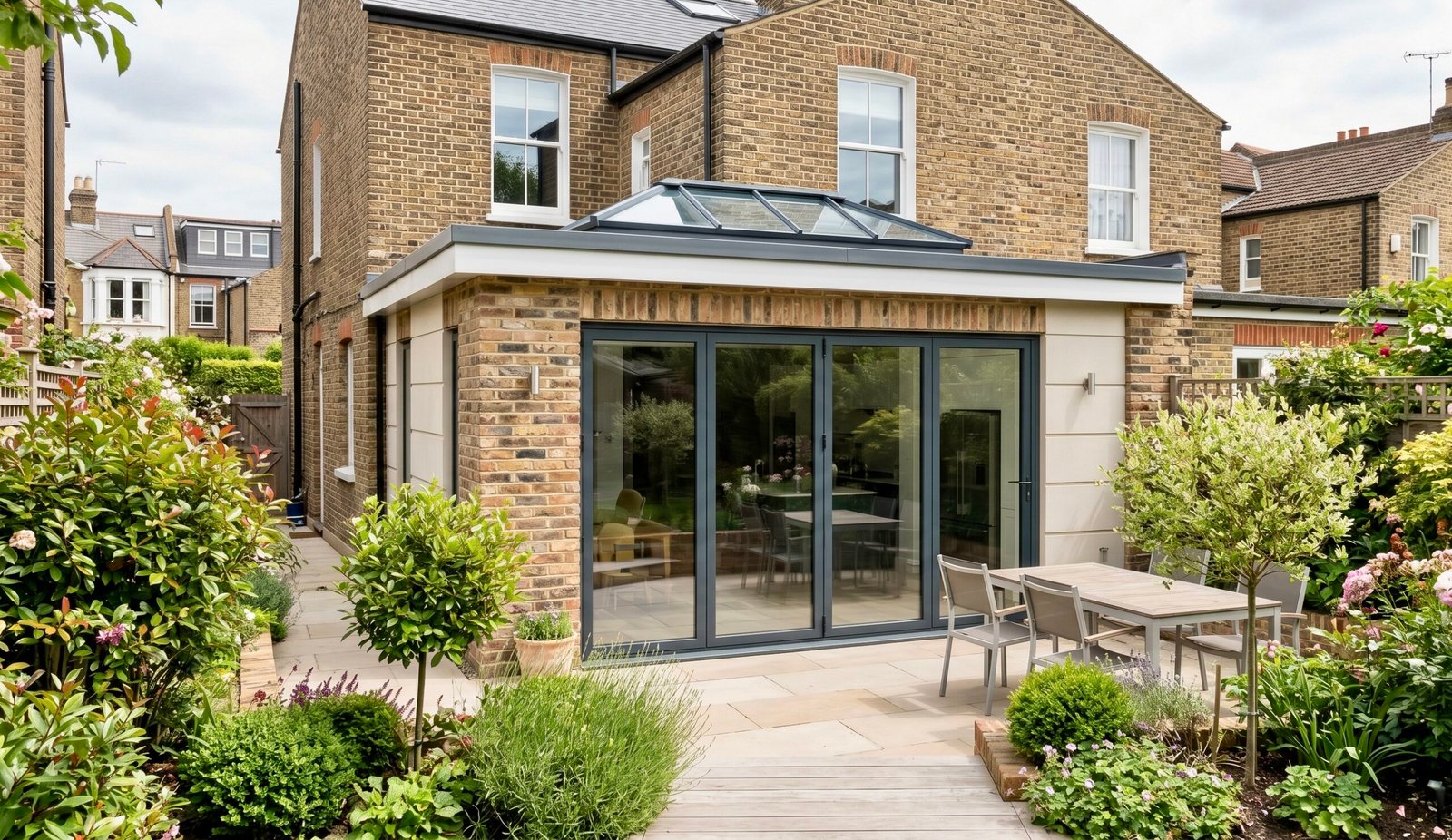
House extension cost in London is one of the most searched questions among homeowners who want more space without the upheaval of moving. The honest answer is that prices vary significantly depending on extension type, size, specification level, and which London borough the property is in — but this guide sets out exactly what to expect in 2026, with real price ranges for every scenario.
At Signature Build Properties, we design and build house extensions across West and South West London, including Chiswick, Richmond, Teddington, Hammersmith, Wimbledon, Putney, Fulham, Barnes, Ealing and the surrounding boroughs. This guide is based on real project experience, not generic online estimates. We confirm your extension cost at a free site survey — no obligation, no pressure.
House Extension Cost London — The 2026 Overview
The cost of a house extension in London sits consistently higher than the national UK average, and for good reason. Land values, labour rates, material delivery in dense urban areas, and the complexity of working with Victorian and Edwardian terraces all contribute to the premium. As a baseline, homeowners in London should budget from approximately £2,500 to £4,500 per square metre for a single storey rear extension, depending on specification.
The figures below represent realistic 2026 budgets for London-based projects at standard and premium specification levels. These are all-inclusive costs covering structural work, foundations, external finishes, internal plastering, first fix electrics and plumbing, and project management — but excluding kitchen or bathroom fittings, flooring, and decorating, which vary widely based on client preference.
Cost Ranges at a Glance
A 20–30m² kitchen-diner or garden room extension at standard to mid-range specification. The most common extension type in West London Victorian terraces.
Adds two levels simultaneously — typically a kitchen-diner below and a bedroom or bathroom above. The best value-per-square-metre extension type for London homes.
Infills the narrow alley beside a terrace to widen the ground floor. Particularly popular in Chiswick, Ealing and Hammersmith Victorian terraces.
Combines a rear extension with a side return to create a large open-plan ground floor. Ideal for families wanting to transform the entire back of their home.
Architect-designed extension with glazed roof lanterns, bifold or sliding doors, underfloor heating, structural glazing, bespoke joinery and high-end finishes throughout.
The London cost per m² benchmark for a well-specified single storey extension. Premium projects — particularly in Kensington, Chelsea or Wimbledon — regularly exceed £5,000/m².
These are market rates for 2026 based on our project experience across West and South West London. The single biggest factor that moves costs up is specification — from standard double-glazed windows to structural steel and frameless glass. We explain exactly where your money goes at the free site survey.
What Affects House Extension Costs in London?
Two homeowners with identical-sized houses in the same street can receive extension quotes that differ by £40,000 or more. Understanding what drives those differences is essential before approaching any builder or architect. The following factors are the primary cost drivers for house extensions in London in 2026.
The Key Cost Drivers
The single biggest lever. Moving from UPVC windows to aluminium bifold doors, adding roof lanterns, or choosing engineered oak flooring over laminate can add £20,000–£50,000 to an otherwise identical project.
Removing a load-bearing wall to open the ground floor requires structural steel and an engineer's calculations. In older Victorian properties this can add £8,000–£18,000 to the structural package alone.
A 20m² extension versus a 40m² extension is not simply double the price — preliminary costs such as planning, foundations and scaffolding are largely fixed regardless of size, so larger extensions deliver better value per m².
London clay is notoriously unpredictable. Properties near trees may require deeper foundations or soil investigation. Ground-floor level differences between the house and garden add further cost in substructure work.
Labour and logistics costs in Inner London (Kensington, Chelsea, Islington) are higher than Outer West London (Ealing, Hounslow, Richmond). Parking restrictions and skip permits also add to costs in dense areas.
Older London homes regularly reveal lead pipework, asbestos materials, or substandard original brickwork once work begins. A contingency of 10–15% of the total project cost should always be held in reserve.
Single Storey Extension Cost London — Full Breakdown
The single storey rear extension remains the most popular choice for London homeowners, and accounts for the majority of the extension projects Signature Build Properties undertakes in West and South West London. The typical project involves extending the rear of a Victorian or Edwardian terrace to create a larger kitchen-diner or open-plan living space connecting to the garden.
The table below shows a realistic cost breakdown for a 25m² single storey rear extension in West London at mid-range specification, based on 2026 pricing.
Single Storey Extension — Indicative Cost Breakdown (25m²)
| Cost Element | Estimated Cost | Notes |
|---|---|---|
| Foundations and Substructure | £8,000–£14,000 | Strip or pad foundations depending on ground conditions. London clay can increase this significantly. |
| Structural Frame and Steelwork | £3,500–£9,000 | Required where a load-bearing rear wall is removed. Structural engineer calculations included. |
| External Walls and Brickwork | £7,000–£12,000 | Cavity wall construction with insulation, matching facing brickwork to existing property where required. |
| Flat or Pitched Roof | £6,000–£14,000 | Modern flat roof with GRP or EPDM membrane. Pitched option increases cost but may suit some properties better. |
| Roof Lantern or Glazing | £4,500–£12,000 | Structural roof lantern or large skylights above a flat roof. A premium feature that significantly improves natural light. |
| Bifold or Sliding Doors | £4,000–£10,000 | Aluminium bifold doors to the garden are standard in London extensions. Sliding or stacking glass systems cost more. |
| First Fix — Electrics and Plumbing | £4,000–£7,000 | Full electrical installation to Part P, including underfloor heating pipework if specified. |
| Plastering and Internal Finishes | £3,000–£5,500 | Skim plaster to all internal walls and ceiling. Does not include decoration. |
| Architectural Drawings and Building Regs | £2,500–£4,500 | Full architectural package including planning drawings (where required) and building regulations submission. |
| Project Management | Included | Included in all Signature Build Properties contracts. Dedicated site manager throughout the build. |
| Total (Mid-Range Spec, 25m²) | £52,000–£88,000 | Excludes kitchen fittings, flooring, decoration, and any client-supplied fixtures. Includes all structural work. |
Double Storey Extension Cost London — Is It Worth It?
A double storey extension adds living space on two floors simultaneously, and represents the best value per square metre of any extension type in London. Because the foundations, scaffolding, external walls and roof are shared across both levels, the cost of adding the second storey is significantly lower than building a separate single storey extension would be at a later stage.
For London homeowners with space on the rear or side of their property, a double storey extension offers a compelling answer to the choice between extending and moving. The additional bedroom or bathroom on the upper level directly increases the marketable floor area of the property, which in premium London boroughs delivers a strong return on the construction cost.
Why a Double Storey Extension Stacks Up
What You Get
- New kitchen-diner or open-plan living space at ground level
- Additional bedroom, bathroom or study on the first floor
- 50–60m² of new living space from a single build programme
- Shared structural costs across two floors
- Single scaffolding erection and dismantling cost
- One planning application covering both storeys
- Typically adds one full bedroom to the property count
- Proportionally higher property value uplift than single storey
Points to Consider
- Always requires full planning permission — not Permitted Development
- Neighbour relations must be considered from the outset
- Party wall agreements required for semi-detached and terraced homes
- More structural disruption during the build than a single storey project
- Higher upfront cost requires confident financial planning
- Design must respect rear elevations visible from neighbouring gardens
- Requires careful consideration of overlooking windows at first floor level
In areas such as Richmond, Wimbledon, Putney and Chiswick, a well-designed double storey extension regularly adds £120,000 to £200,000 or more to the market value of a family home — making it one of the most financially sound improvements a London homeowner can undertake.
Side Return Extension London — Costs and What to Expect
The side return extension is a defining feature of London's Victorian terrace streetscape. The narrow strip of land running alongside the kitchen — typically 1 to 2 metres wide and running the full depth of the ground floor — is often wasted as a dark passageway. Extending into this space opens up the entire rear of the house and transforms both the kitchen and the connection to the garden.
Side return extensions are particularly common in West London boroughs where Victorian terraced housing stock is dense — including Chiswick, Ealing, Hammersmith, Fulham, Putney, and Barnes. Because the footprint is relatively modest, the per-square-metre cost tends to be higher than a full rear extension, but the transformation to the home is often disproportionate to the size gained.
Side Return Extension — Typical London Costs
Infills the alley with a flat roof, standard glazing, and mid-range finishes. Typically 8–14m² of additional floor area, transforming a narrow kitchen into a usable open-plan space.
Includes a roof lantern, full-width aluminium doors to the garden, quality tiling, and connection to an extended kitchen. The most popular specification in West London.
Structural glazing, full-height sliding glass doors, bespoke joinery, underfloor heating, and seamless flow between inside and outside. Common in Fulham, Barnes and Chiswick premium renovations.
Where a side return is combined with a full rear extension to create a large L-shaped footprint. Costs from £75,000 to £130,000+ and delivers a transformative open-plan ground floor layout.
Extension vs Moving — The London Homeowner's Decision
For many London homeowners, the question is not simply how much a house extension costs — it is whether an extension makes more financial and practical sense than selling and buying a larger property. In 2026, with stamp duty, estate agent fees, solicitor costs and the upheaval of a move, the financial case for extending rather than moving is stronger than it has been for many years.
The table below compares the true cost of extending against the cost of moving to a property with one additional bedroom in a comparable London area, based on a home currently valued at £750,000.
Extending vs Moving — The True Cost Comparison
| Cost Element | Extending | Moving |
|---|---|---|
| Core Cost | £60,000–£120,000 (extension build) | £50,000–£150,000+ (price gap to next property) |
| Stamp Duty | None | £25,000–£50,000+ on a London property |
| Estate Agent Fees | None | £12,000–£20,000 (selling and buying) |
| Solicitor and Survey Costs | None | £3,000–£6,000 |
| Removal Costs | None | £1,500–£5,000 |
| Time Disruption | 10–16 weeks on site | 6–12 months (chain, searches, completion) |
| School / Community Impact | None — you stay in your area | Potential change of catchment area |
| Property Value Uplift | Typically 15–25% in premium London areas | None — you purchase at full market price |
In most scenarios, London homeowners who choose to extend rather than move save £40,000–£80,000 in transaction costs alone — before accounting for the value uplift the extension delivers to the property. For families in well-established neighbourhoods in Richmond, Teddington, Wimbledon, or Chiswick, this calculation makes extending a particularly clear decision.
Planning Permission for House Extensions in London — What You Need to Know
Not every house extension in London requires a full planning application. The majority of single storey rear extensions on residential properties qualify under Permitted Development rights — a national planning policy that allows defined building works without the need for council approval. Understanding where the line falls before approaching a builder or architect saves time and avoids incorrect budget assumptions.
Permitted Development Rules for London Extensions
Can extend up to 3 metres beyond the original rear wall under standard rules, or up to 6 metres under the Prior Approval Neighbour Consultation Scheme. Must not exceed 4 metres in height.
Can extend up to 4 metres under standard PD rules, or up to 8 metres under the Prior Approval Scheme. Must not exceed 4 metres in height at the eaves or ridge.
Single storey side extensions can qualify under PD if they do not exceed half the width of the original house and meet height limits. Always verify with your local authority before proceeding.
All double storey extensions to the rear of a property require full planning permission. The application must also address any overlooking concerns from upper-floor windows to neighbouring gardens.
Properties within London's many conservation areas — including parts of Richmond, Chiswick, Hammersmith, Wimbledon and Islington — have restricted or removed Permitted Development rights. All extension types require planning permission.
Building regulations approval is mandatory for all house extensions regardless of planning status. This covers structure, fire safety, drainage, insulation and the electrical installation. Signature Build manages all submissions on your behalf.
The House Extension Process — From Enquiry to Completion
One of the most common frustrations London homeowners report when researching extensions is not understanding what the process actually involves — and therefore being unable to plan realistically. The following is Signature Build Properties' standard process for a West London house extension project, from the initial enquiry through to receiving the building control completion certificate.
Free Site Survey — Week 1
A project manager visits your property to assess the feasibility of the extension, check structural constraints, review ground conditions, and confirm your planning position. We advise on the most suitable extension type for your property and your objectives. This visit is always free and carries no obligation.
Design and Architecture — Weeks 2 to 5
Our architectural team produces the initial concept drawings based on the site survey notes and your brief. Revisions are discussed and agreed before the drawings are finalised to planning or building regulations standard. There is no separate architectural fee when you build with Signature Build Properties — design is included in the project.
Planning and Approvals — Weeks 4 to 16
Where planning permission is required, we submit the full application through the Planning Portal on your behalf and manage the process with the planning officer. Where the extension qualifies under Permitted Development, we apply for a Lawful Development Certificate to protect your position on any future property sale. Building regulations drawings are submitted in parallel.
Party Wall Notices — Weeks 4 to 8
For any extension work adjacent to or connected with a shared wall, we serve the correct party wall notices on your neighbouring properties under the Party Wall etc. Act 1996. Where neighbours provide written consent, no surveyor is required. We manage the entire process on your behalf.
Construction — Typically 10 to 16 Weeks
Our directly employed trades begin on site following the issue of approvals. A dedicated site manager oversees all stages of the build, with a building control inspector attending at key structural and completion stages. You receive weekly updates throughout the project. The typical single storey extension build programme runs 10 to 14 weeks from ground break to practical completion.
Completion and Sign-Off
On practical completion, the building control inspector carries out a final inspection and issues the completion certificate. This document confirms that all work complies with building regulations and must be kept safely — solicitors and mortgage lenders will ask for it on any future sale or remortgage. We also apply for the final Lawful Development Certificate where applicable.
How to Get an Accurate Extension Quote in London
Online house extension cost calculators are useful for an initial ballpark figure, but they cannot replace a proper site assessment. The difference between an online estimate and a real project quote regularly runs to £15,000–£40,000 — in either direction — because they cannot account for ground conditions, structural complexity, property layout, access restrictions, or specification choices.
To obtain a reliable, accurate quote for a house extension in London, homeowners should follow these steps before committing to any builder or architect.
Getting a Reliable Extension Quote
Steps to Take
- Book a free site survey with at least two reputable builders
- Prepare a brief describing what you want the extension to achieve
- Confirm your planning position before requesting quotes
- Ask each builder to quote to the same specification for fair comparison
- Request a full itemised breakdown — not a single lump sum
- Check whether architectural drawings are included or charged separately
- Ask what is excluded from the quote (floors, decoration, kitchen)
- Ask about the builder's approach to unforeseen works and variations
- Verify the builder carries full public liability and employer's insurance
- Request references for similar London extension projects
Red Flags to Watch For
- A quote significantly below all others — often reflects underspecification
- No site visit before quoting — impossible to quote accurately remotely
- Vague or one-page quotes with no line-item breakdown
- Requests for large cash deposits upfront before work starts
- No mention of building regulations or structural engineer
- No written contract or programme provided before you sign
- Builder cannot name recent local projects or provide references
- Reluctance to discuss party wall or planning obligations
Frequently Asked Questions
House Extension Cost London — Common Questions
How much does a house extension cost in London in 2026?
In 2026, a single storey rear extension in London typically costs between £45,000 and £88,000 for a 20–30m² project at mid-range specification. A double storey extension costs from £80,000 to £140,000. These figures exclude kitchen fittings, flooring and decoration. Premium specification projects — particularly in Kensington, Chelsea, Richmond or Wimbledon — regularly exceed these ranges. The most accurate way to understand the cost for your specific property is a free site survey, which we offer with no obligation.
How much does a single storey extension cost per square metre in London?
In London, a single storey extension costs approximately £2,500 to £4,500 per square metre at standard to mid-range specification in 2026. High-specification projects — with structural glazing, roof lanterns, underfloor heating and premium finishes — regularly reach £5,000 to £6,500 per square metre in prime West and South West London boroughs. The per-square-metre cost also tends to be higher on smaller extensions, where fixed costs such as foundations, scaffolding and architectural fees are spread across less floor area.
Does a house extension add value in London?
Yes — in most London boroughs, a well-designed house extension adds significantly more value than it costs to build. A single storey kitchen extension in Chiswick, Richmond, or Wimbledon typically delivers a return of between 15% and 25% on the property's pre-extension value, according to estate agent valuations on completed projects. A double storey extension that adds a bedroom can add 20–30% to the value. The return is stronger where the existing property is under-spaced relative to neighbouring homes, and where premium specification matches buyer expectations in the area.
How long does a house extension take in London?
A single storey rear extension typically takes 10 to 14 weeks on site from ground break to practical completion, assuming planning permission is in place. Including the design and planning phase, the full project from initial enquiry to completion is typically 5 to 8 months for a straightforward PD extension, or 8 to 12 months where full planning permission is required. A double storey extension typically adds 4 to 6 weeks to the on-site programme.
Do I need planning permission for a rear extension in London?
Most single storey rear extensions in London qualify under Permitted Development and do not require a full planning application. Under the standard PD rules, terraced and semi-detached houses can extend up to 3 metres from the original rear wall, while detached properties can extend up to 4 metres. Under the Neighbour Consultation Scheme — also known as the larger home extension scheme — these limits increase to 6 metres and 8 metres respectively, subject to neighbour consultation. Conservation areas and listed buildings always require full planning permission regardless of extension type. We confirm your planning position at the free site survey.
What is the best type of house extension for a London terrace?
For a London Victorian or Edwardian terrace, the most popular and cost-effective options are a rear extension, a side return extension, or a combination of both — known as a wrap-around extension. The right choice depends on the available space, planning constraints, and what the homeowner wants to achieve. A side return extension is particularly effective where the existing kitchen is narrow and dark, as it dramatically improves the width and light of the ground floor. A rear extension delivers more square footage at a lower per-metre cost. We advise on the best approach for your specific property at the free site survey.
Do you include architectural drawings in your house extension quotes?
Yes — Signature Build Properties includes all architectural drawings, planning application management, structural engineer calculations, and building regulations submission within our project service. There is no separate architectural fee when you build with us. This is particularly useful for London homeowners who want a single point of contact and a fixed-price contract that covers the full process from planning through to final sign-off.
Coverage and Next Steps
Which areas of London do Signature Build Properties cover for house extensions?
We build house extensions across West and South West London, including Chiswick, Richmond, Teddington, Hammersmith, Ealing, Hounslow, Acton, Fulham, Putney, Barnes, Wimbledon, Kingston upon Thames, Surbiton, Islington, Clapham, Battersea, Dulwich, Roehampton, and all surrounding boroughs. Contact us to confirm coverage for your specific postcode.
Final Thoughts on House Extension Costs in London
Planning a house extension is one of the most significant financial decisions a London homeowner will make, and getting the budget right from the outset is essential. The key principles are consistent: specification drives cost more than size; London premiums are real but manageable with the right builder; and the financial case for extending rather than moving is stronger in 2026 than it has been for years.
The most reliable path to an accurate budget is a proper site survey — not an online calculator or a quote provided without a visit. At Signature Build Properties, every project begins with a free site survey at which we assess the structural feasibility, confirm the planning position, and provide a detailed, itemised cost guide tailored to the specific property.
Homeowners across Chiswick, Richmond, Teddington, Hammersmith, Wimbledon, Fulham, Putney, Barnes and the wider West and South West London area are welcome to contact us to arrange a free, no-obligation survey at a time that suits them.
Get an Accurate Extension Cost for Your London Home
Book a free site survey with Signature Build Properties. We visit your property, assess the feasibility, confirm your planning position, and provide a detailed cost guide — completely free, no obligation.
Book Free Survey +44 7404 931629