
We design and build house extensions across West London: single storey rear, side returns, wrap-arounds and double storeys. Trading since 2010, every job starts with a free design consultation and structural feasibility check. Architect drawings, planning, party wall agreements and the build itself are all managed end to end, with a fixed price written down before any work begins.
Two reasons. First, the builder quotes off architect drawings without a structural survey, so the foundations come back twice the spec they costed. Second, they price on “labour and materials” instead of a fixed contract, so every variation becomes a £2,000 add-on. Both turn an £80k build into a £110k build.
At Signature Build Properties, we do it differently. Our in-house architect and a structural engineer assess the property on day one. We cost the build from a full spec, not a sketch. The fixed contract price is locked in writing before any work begins, so the final invoice matches the quote.
We work out of Hayes in West London, so our projects cover the area’s mix of Victorian terraces, Edwardian semis, 1930s stock and conservation area properties. Each property type has its own structural and planning quirks, and we’ve extended all of them. View recent projects.
Signature Build handled our house extension in Hayes from start to finish, including getting the planning permission…
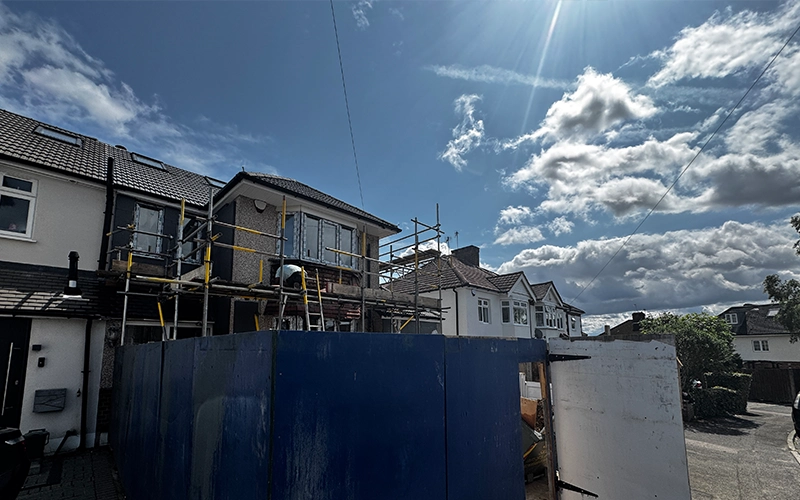
These four types cover about 95% of West London extension projects. The right one for your home depends on plot shape, ceiling heights, party wall position and what you want to do with the space. Want a rough cost first? Try our free cost calculators.
The most common London extension. Up to 3 metres deep for terraces and semis, or 4 metres for detached homes, under permitted development. Larger 6m (terrace/semi) or 8m (detached) builds are possible via a prior-approval application. Steel goal-post, rooflights or lantern roof, bifold or sliding doors to the garden. Adds 18–35m².
Fills in the narrow alley alongside Victorian terraces, opening the kitchen into a wider single space. Almost always permitted development. Lantern roof and bifolds to the garden. Strong return on the resale market. Adds 8–14m².
Combines a side return with a rear extension to fully open the back of the house. Creates a 30m²+ open-plan kitchen-living-dining space. Usually needs full planning since it exceeds permitted development on terraces. Worth the planning step.
Two-floor extension adding both ground floor living space and a bedroom or bathroom above. Often the best value since it doubles the added square metres without doubling the cost. Needs full planning. The foundations spec is critical.
We work out of Hayes and cover nine sub-regions. Each borough has different planning quirks. Ealing council enforces conservation areas tightly. Hounslow approves permitted development quickly. Richmond and Twickenham need lime-friendly material specs. Local knowledge saves weeks at planning stage. We also have dedicated pages for house extensions in Richmond.
The Victorian terrace heartland. Most jobs here are side returns or wrap-arounds. Ealing council is strict on conservation areas, especially Chiswick and parts of Hanwell. We handle the design statements and heritage submissions in-house.
Premium streets with premium extension budgets. Wrap-arounds and full double-storeys dominate. H&F council planning and party wall complexity push timelines longer, but the return on resale value is among the strongest in London.
1930s semi-detached and inter-war stock. Generous plots usually mean single storey rear extensions sail through permitted development. Our home territory, so site visits are same-day and material delivery from local merchants is fast.
Mixed housing stock from Victorian to 1960s. Hounslow council processes permitted development applications quickly. Larger rear extensions and double-storeys are common, especially on the bigger 1930s semis with deep gardens.
A high concentration of conservation areas and listed buildings. Our drawings use lime-friendly material specs and heritage-appropriate detailing for the planners. See our dedicated Richmond extensions page.
South-west London affluent residential. Big Edwardian semis and detached Victorians dominate. Wrap-arounds, side returns and double-storeys all common. Wimbledon and Barnes both have multiple conservation area zones we know well.
Suburban family homes with good-sized gardens. Single storey rear extensions and double-storey side extensions on the 1930s semis are our most common jobs here. Council planning is reasonable, with decisions usually back in around 8 weeks.
Mixed inter-war and Victorian stock. Many properties already have small extensions from previous decades, which creates structural complexity when adding more. We assess existing load paths properly before quoting on second-phase extensions.
Larger detached properties on bigger plots. Generous rear extensions, double-storey side extensions and annexe builds. Some properties sit within green belt restrictions or near the Thames floodplain, so we check planning constraints first.
West London is dominated by period properties, and extending them well is a craft. Solid 9-inch brick walls with no cavity. Original suspended timber floors with shallow foundations. Lime mortar that can’t take modern cement render. Existing chimney stacks that need careful structural assessment before any wall comes down.
Many builders treat these like new builds, with concrete strip foundations and cement-bonded brickwork that fights the original structure. We design extensions that work with the period property, not against it: deeper pad foundations to handle differential settlement, breathable lime-friendly junctions where new meets old, and structural steels that respect the existing load paths.
This matrix maps the most common West London property types to the extension that delivers the best value and least planning friction. Use it as a starting point, as every property still needs a site survey before final design.
| Property Type | Best Extension | Typical Budget | Planning Route |
|---|---|---|---|
| Victorian mid-terrace | Side return + rear | £55,000 – £85,000 | Permitted dev. or planning |
| Edwardian semi-detached | Wrap-around or double storey | £70,000 – £130,000 | Planning usually needed |
| 1930s semi-detached | Single storey rear + side | £40,000 – £75,000 | Permitted development |
| Modern detached | Double storey side | £80,000 – £140,000 | Planning required |
| Bungalow | Rear + loft conversion | £60,000 – £110,000 | Permitted dev. (mostly) |
| Conservation area period | Sympathetic side or rear | £55,000 – £120,000 | Planning + heritage |
The figures below are based on extension jobs across West London. Every quote is locked in writing before any work begins, so the final invoice matches the contract. For a detailed breakdown, see our full house extension cost guide.
A typical single storey rear extension in London runs £30,000 to £55,000 for 18–25m². A side return on a Victorian terrace sits at £45,000 to £70,000. Wrap-arounds start around £60,000 and reach £100,000+ on bigger plots. Double storeys run £75,000 to £140,000. The final price depends on spec, finishes and site complexity, and we fix it upfront after the design and structural survey.
| Extension Type | Typical Cost | Size Added | Build Time |
|---|---|---|---|
| Free Design Consultation | Free | – | 1–2 hours |
| Architect Drawings + Planning | £2,500 – £5,500 | – | 10–14 weeks |
| Single Storey Rear (small) | £30,000 – £45,000 | 15–22m² | 8–10 weeks |
| Single Storey Rear (large) | £45,000 – £65,000 | 23–35m² | 10–12 weeks |
| Side Return Extension | £45,000 – £70,000 | 8–14m² | 10–14 weeks |
| Wrap-Around Extension | £60,000 – £100,000 | 22–35m² | 12–16 weeks |
| Double Storey Side | £75,000 – £120,000 | 30–50m² | 14–18 weeks |
| Double Storey Wrap-Around | £110,000 – £180,000 | 45–70m² | 16–22 weeks |
All prices include VAT, materials, labour, building control and structural calcs. Indicative for London 2026. For independent benchmarks, see Checkatrade's house extension cost guide or Architecture for London's cost analysis.
Every project we do follows the same six steps. No scope creep, no cost-plus surprises, no rushed-through planning that gets refused.
Our architect and a structural engineer visit your property. We measure up, discuss your brief, and talk through extension type, planning route and rough budget. You get initial sketches within a week, with no commitment to proceed.
We prepare and submit the planning or permitted development application. If neighbours are within 3 metres of the new foundations, we appoint a party wall surveyor and serve the legal notices. Both happen in parallel to save weeks.
Once planning is approved and structural calculations are signed off, we issue the fixed-price build contract. Every line item is costed: groundworks, brickwork, steels, glazing, electrics, plastering, finishes. No “labour and materials” guesses.
Site setup, scaffolding, foundations dug and inspected by building control. Steel goal-post or transfer beam installed. Brickwork raised, structural openings formed. Roof on, watertight. Usually 4–6 weeks for a single storey.
Electrics, plumbing and heating first fix. Plasterboard, screed floor, glazing installed. Then second fix: kitchen units, sanitaryware, sockets and switches, plastering, painting. All trades sequenced by our site manager.
We walk through with you, list any snags, and fix them within 5 working days. Building control sign-off issued. Your 2-year workmanship guarantee starts on handover. A 10-year insurance-backed warranty is available for an extra £350.
A well-built extension adds usable space and can lift a London property’s resale value, while avoiding the stamp duty and moving costs of trading up the ladder. If you’ve been thinking about it, this year is usually the right one to act.
Ealing W5, Hanwell W7 and Acton W3 have one of London’s highest concentrations of Victorian terraces, which means side returns and wrap-arounds dominate the local market. Our team works across the Ealing borough regularly.
Ealing’s Victorian terrace stock typically has a narrow side return alley between the kitchen and the boundary wall, plus a small original rear addition. Filling that alley with a side return extension creates a much wider open-plan kitchen-diner without needing planning permission in most cases.
Conservation area status covers Bedford Park, Hanwell village and parts of Ealing Common. Properties within these areas need design statements showing the extension is sympathetic to the historic character. We’ve completed conservation area extensions across Ealing and know what the planners want to see.
For an extension in Ealing, Hanwell, Acton, Chiswick or Northfields, call us on +44 7404 931629 for a free design consultation.
| Extension Type | Ealing 2026 Price |
|---|---|
| Free Design Consultation | Free |
| Side return (Victorian terrace) | £48,000 – £72,000 |
| Single storey rear (semi) | £35,000 – £58,000 |
| Wrap-around extension | £65,000 – £95,000 |
| Double storey side | £82,000 – £125,000 |
| Conservation area premium | +10 to 20% |
| Bedford Park heritage premium | +15 to 25% |
Extension projects go wrong for predictable reasons. Watch for these six warning signs before signing any quote, ours included. A good builder will pass all six without breaking a sweat.
If the builder works from architect drawings alone, expect cost surprises when the foundations need redesign mid-dig. Insist on structural calcs before any quote is given. We always include this in the design stage.
A “labour and materials” quote means every variation becomes an extra. Builders use this to win the job low and inflate later. A proper fixed-price contract caps your risk. Ours is locked in writing before work starts.
Anything above 15–20% before materials arrive is a cash-flow problem on their end. Legitimate builders stage payments against milestones: footings, brickwork, watertight, first fix, completion.
If your extension is within 3 metres of a neighbour’s property, the Party Wall Act 1996 applies. Skipping it is risky: a neighbour can stop the build via court injunction. We handle the surveyors and notices in-house.
Glazing needs a FENSA-registered installer for building control. Boilers and gas need Gas Safe registration. Plumbing for unvented cylinders needs a G3-qualified plumber. If the builder hand-waves this, walk away.
A genuine West London extension builder has completed jobs nearby. Ask for recent projects or reviews you can check. If they dodge or send only “private references,” there’s usually a reason. You can read our reviews on Google and Checkatrade.
No invented case studies here, just verifiable proof. We’re a registered limited company, insured, a Checkatrade member, and rated by real customers on Google.
Verified reviews from real customers across West London. Read them here.
Independently vetted trade membership. View our profile.
Public liability insured and registered as Signature Build Properties Ltd at Companies House.
Every build carries a 2-year written workmanship guarantee, with a 10-year insurance-backed warranty available.
Our architect and a structural engineer visit your property, discuss your brief, sketch initial designs and give an honest rough budget. No commitment, no obligation, no sales pressure, just the information you need to make a confident decision.