
Damp proofing London done properly. Since 2010 we've fixed 800+ damp problems across West London: rising damp, penetrating damp, black mould, condensation. Every job starts with a proper diagnostic survey using moisture meters and thermal imaging. That way you get the right treatment for the actual cause, not a guess. Fixed price written before any work begins. Same-week visits across all London boroughs.
Half the damp firms in London will quote you DPC injection without ever testing your wall. The other half will sell you waterproof paint. Both will tell you the problem is fixed. Six months later, the damp's back and worse than before.
At Signature Build Properties, every job starts with a proper diagnostic. We use moisture meters, thermal imaging, salt analysis and external inspection to identify what's actually causing the problem. That way you get the right treatment for the actual issue, not a generic DPC injection sold to every house we walk into.
We work out of Hayes in West London, so our damp proofing London work covers the borough's mix of Victorian terraces, Edwardian semis, 1930s stock and modern flats. Each property type carries its own damp pattern. We've treated all of them. View recent damp projects.
Damp also rarely arrives alone. A leaking gutter or failed flashing usually needs our roofing team, cracked or blown external render lets water straight through a solid wall until it is repaired by our rendering service, and once the walls are dry, our home renovation team replasters and redecorates as part of the same project. One company, one guarantee, no finger pointing between trades.
Two other firms quoted us £3,500 for "rising damp treatment" without lifting a moisture meter. Signature actually surveyed, found the real cause was a leaking gutter, fixed it for £400 and saved us thousands.
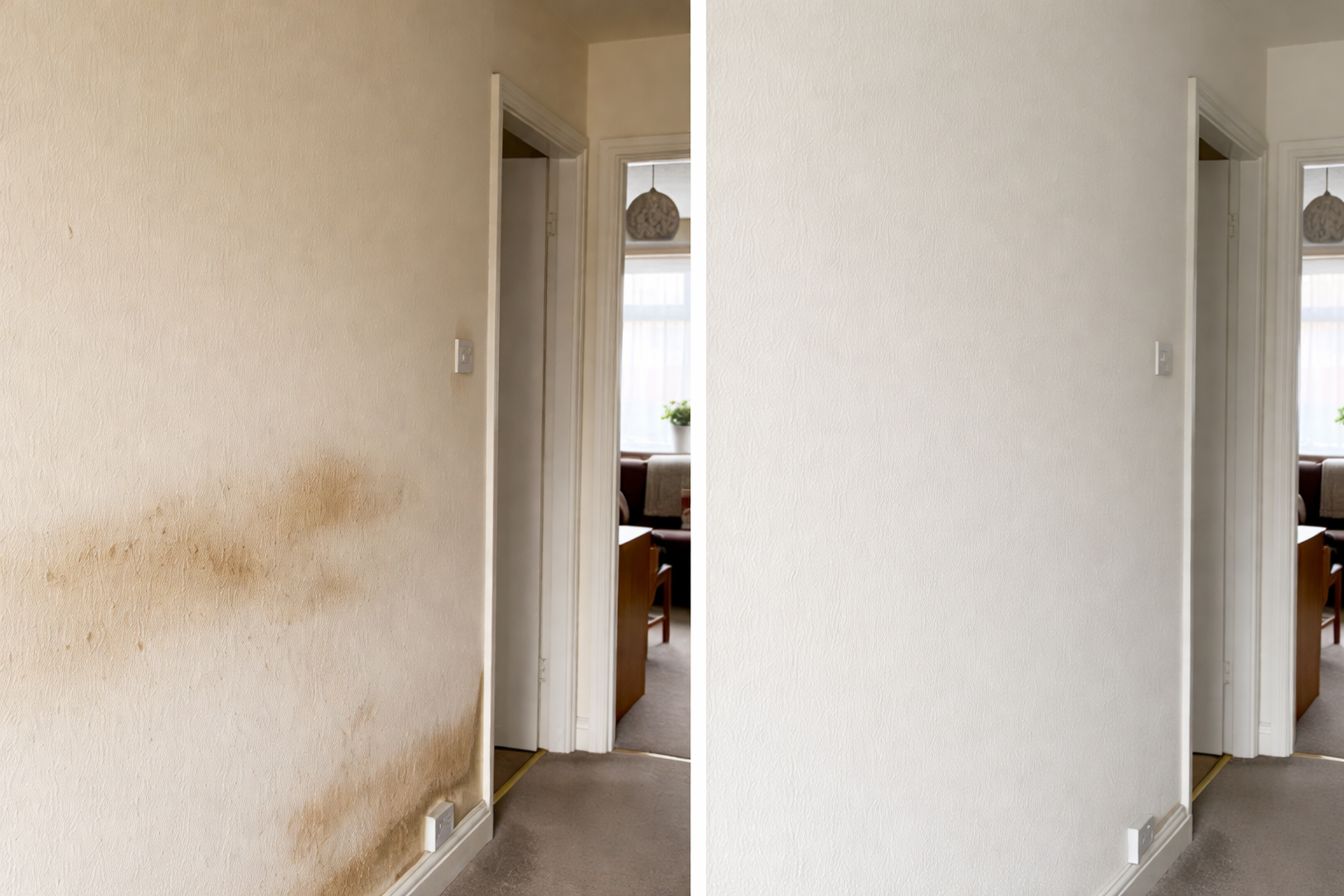
The four damp types below each need a completely different treatment. Get the diagnosis wrong and the damp comes back. Want a rough cost first? Try our construction calculators.
A chemical damp proof course (silicone DPC injection) at low wall level creates the barrier. We hack off the salt-contaminated plaster and replaster with salt-resistant backing render. Two to three days, walls touch-dry the next week.
We trace the external entry point (failed pointing, leaking gutter, faulty roof flashing) and seal it at source. Then we treat the wall internally so the damp's gone for good. Not just covered up.
We safely remove the mould with HEPA-filtered equipment, treat the walls with anti-fungal biocide and sort the ventilation that caused it. Just painting over mould guarantees it comes back within months.
We install positive input ventilation (PIV) units, upgrade extract fans where needed, and apply anti-condensation coatings. The point is to break the moisture cycle, not just wipe down the windows every morning.
We work out of Hayes and cover nine sub-regions. Every neighbourhood has its own damp pattern. A Victorian terrace in Hanwell gets rising damp from raised ground levels. A 1930s semi in Hayes usually has condensation from poor ventilation. Our diagnosis is always property-specific, never one-size-fits-all.
Mostly Victorian and Edwardian terraces. 90% of our damp calls here involve rising damp through bridged DPCs. Raised garden levels over a century have buried the original slate DPCs, letting groundwater wick upward through the brick.
Converted period flats dominate the borough. Basement flats here see frequent penetrating damp from raised pavement levels and Victorian drainage issues. Both are treatable at source.
1930s semi-detached stock predominates. These properties usually suffer condensation rather than rising damp. Poorly ventilated kitchens and bathrooms drive moisture into bedroom walls and ceilings.
The housing mix here produces every kind of damp issue. Our diagnostic survey is critical, because guessing the cause from symptoms alone fails half the time in mixed-stock postcodes like these.
Period property heartland, plus conservation area constraints add complexity. Our team uses lime-based materials and breathable systems instead of modern cement render on listed buildings, since cement traps moisture inside solid walls.
South-west London affluent residential streets mix Victorian terraces with 1930s semis and modern townhouses. Briefs here range from basement tanking to whole-house DPC installations on the bigger period properties.
Suburban family homes that suffer condensation from inadequate ventilation. PIV (positive input ventilation) systems paired with anti-mould treatments are our most common solution across Kingston and New Malden.
Mixed stock from Victorian terraces to inter-war semis. Many properties have been altered repeatedly over decades, which creates bridged DPCs and concealed damp paths that only show on a proper survey.
Larger detached properties and proximity to the Thames raise the risk of penetrating damp and basement moisture. Basement tanking and cavity drain systems feature heavily in our Surrey commuter belt work.
West London is dominated by period properties, and period damp problems are uniquely complex. Solid 9-inch brick walls with no cavity. Perished or non-existent original DPCs. Raised garden levels burying what's left of them. Suspended timber floors with blocked sub-floor vents.
Generic damp treatments designed for modern cavity walls just don't work here. We start every period property job with a full structural damp survey, then identify whether the problem is rising damp, lateral penetration, sub-floor ventilation failure or condensation from poor heating patterns. Then we match the treatment to the actual cause. Not the easiest symptom to spray with chemicals. Renovating a period property from top to bottom? Damp treatment slots into the wider programme, see our Victorian and Edwardian restoration service.
This matrix maps the most common damp symptoms we see to their likely cause and treatment. Use it as a guide, but never start treatment without a proper survey. Symptoms often mask the actual cause.
| Symptom You See | Likely Cause | Recommended Treatment | Typical Cost |
|---|---|---|---|
| Tide marks low on walls, salt deposits | Rising damp, failed DPC | DPC injection plus replaster | £800 to £2,000 |
| Single damp patch, worse after rain | Penetrating damp | Seal external source, treat wall | £400 to £1,500 |
| Damp patch on an internal wall upstairs | Penetrating damp or plumbing leak | Trace source, repair, treat wall | £300 to £1,200 |
| Black mould on cold walls and windows | Condensation | PIV plus anti-mould coating | £150 to £600 |
| Damp around chimney breast | Chimney leak, failed flashing | Chimney repair plus repoint | £300 to £900 |
| Lateral damp on basement walls | Hydrostatic pressure | Basement tanking (cavity drain) | £60 to £120/m² |
| Musty smell, rotting skirting | Sub-floor damp, blocked vents | Sub-floor ventilation plus timber treatment | £600 to £1,800 |
Every figure below comes from actual jobs we've completed across West London in the past 12 months. Every quote is locked in writing before any work begins, so the final invoice matches the contract.
It depends on the damp type, severity and area affected. A full rising damp treatment London for a ground floor will run £1,500 to £4,000 including replastering. A damp proof course for an average 3 bed semi sits at £800 to £1,800. A bedroom mould removal job costs £200 to £600. We fix the price upfront after the survey, no surprises.
| Treatment Type | Typical Cost | Duration | Best For |
|---|---|---|---|
| Damp Survey & Written Report | Free | Half day | All properties |
| Black Mould Removal | £200 to £800 | 1 day | Mould patches in bedroom, bathroom |
| Condensation Treatment + PIV | £150 to £600 | 1 day | Condensation, cold-wall mould |
| Damp Proof Course (per wall) | £300 to £800 | 1 day | Single-wall rising damp injection |
| Damp Proof Course, 3 bed semi (full) | £800 to £1,800 | 2 to 3 days | Whole-house chemical DPC injection |
| Rising Damp Treatment, 1 room | £800 to £2,000 | 2 to 3 days | Single room DPC plus replaster |
| Rising Damp, full ground floor | £1,500 to £4,000 | 3 to 5 days | Whole ground floor DPC |
| Penetrating Damp Repair | £400 to £1,500 | 1 to 2 days | External source sealed and treated |
| Basement Tanking (per m²) | £60 to £120 | 3 to 7 days | Lateral damp, basement conversion |
All prices include VAT, materials and labour. Indicative for London 2026. For independent benchmarks, see Checkatrade's damp proofing cost guide.
Every damp proofing London job we do follows the same six steps, starting with a free damp survey. No surprises, no chemical sales pressure, no painted-over symptoms.
Our specialist visits within the same week. We take moisture-meter readings, use thermal imaging to map the damp pattern, and inspect external walls, ground levels, gutters and roof. The point is finding the source, not selling chemicals.
You get a written report with photographs, moisture readings and a clear explanation of the root cause. The fixed-price treatment plan goes in writing too, so you know exactly what the work will cost before anyone signs anything.
We always address the source first: leaking gutter, raised ground level, blocked vent. Otherwise the damp comes back through a freshly painted wall in six months. Fix the cause, then fix the symptom.
Once you've signed off, our team carries out the agreed work. DPC injection, mould removal, penetrating damp repair or PIV install. The work area gets sheeted, protected and kept clean throughout.
Damp-affected plaster gets hacked off, salt-resistant backing render applied, and walls replastered to a smooth finish. Walls are ready to decorate within days, though they'll need 4 to 6 weeks of drying before paint.
We walk through the completed work with you. Your 2-year written workmanship guarantee is issued at handover. If the damp returns within that period, we come back and fix it at no charge.
Damp and mould never resolve on their own. They always get worse over time. If you've spotted any of these signs, book a free same-week survey.
Richmond upon Thames, Twickenham, Kew and Teddington have a high concentration of Victorian and Edwardian properties where rising damp and condensation are the most common issues we treat. Our team works across the Richmond borough every week.
Older brick construction, solid external walls and original suspended timber floors make Richmond properties particularly susceptible to rising damp. The borough's proximity to the Thames also means ground conditions affect moisture levels in lower ground floors and basements.
Conservation area status covers significant parts of Richmond, Kew, Twickenham and Ham. Properties within these areas, and listed buildings specifically, may require lime-based materials instead of standard cement render. We're experienced in working within conservation area requirements and confirm material spec at the free survey. We also build loft conversions in Richmond, so if damp treatment is part of a bigger plan for the house, one survey covers both.
For damp proofing in Richmond, Twickenham, Teddington, Kew, East Twickenham or Hampton, call us on +44 7404 931629 to arrange a free same-week survey.
| Treatment | Typical Cost |
|---|---|
| Free Damp Survey | Free |
| Rising damp (per linear metre) | £70 to £120 |
| Full DPC injection (avg 3-bed) | £800 to £1,800 |
| Condensation treatment + PIV | £400 to £900 |
| Mould removal and treatment | £200 to £600 |
| Basement tanking (per m²) | £60 to £120 |
| Conservation area premium | +15 to 25% |
The damp industry has more cowboys than almost any other UK trade. Watch for these six red flags before signing any quote, ours included.
If the "specialist" quotes from photos or a five-minute visit, they're guessing. Ask to see actual moisture readings on walls before you accept any treatment quote.
When the same treatment gets sold for every property, the diagnosis was never done. Fewer than 20% of damp issues are actually rising damp. DPC injection won't fix the other 80%.
Anything above 25% is a cash-flow problem on their end. Legitimate damp specialists stage payments against milestones, not upfront on contract signature.
"We can start tomorrow with a deposit today" is a cash-grab. No genuine damp specialist has same-day capacity unless something has gone wrong on another job.
The Property Care Association (PCA) certifies legitimate damp surveyors. Anyone calling themselves a "damp expert" without CSRT certification shouldn't be doing paid surveys.
Branded waterproof masonry paint traps moisture in the wall instead of treating it. That guarantees recurrence within 12 months, usually with worse mould growth than before.
The projects below cover rising damp, condensation mould and basement damp. They show what proper diagnosis and treatment actually look like across real West London properties.
This property had damp on three downstairs walls with classic tide marks at low level. Our survey identified the cause as a bridged DPC: the garden level had been raised 200mm over decades, burying the original slate DPC. We installed an 18-metre silicone DPC injection, hacked off salt-contaminated plaster and applied salt-resistant backing render. Walls have been bone dry for 12+ months with the full 2-year guarantee in place.
The brief was urgent: the homeowner's daughter had asthma triggered by black mould around her bedroom window. The cause turned out to be condensation from poor ventilation, not damp ingress. We removed the mould safely using HEPA-filtered equipment, applied anti-fungal biocide and installed a positive input ventilation (PIV) unit in the loft. Bedroom has been mould-free for over a year, with humidity levels dropping from 78% to 52%.
Despite its grand scale, this Edwardian end-terrace had an unusable basement with severe lateral damp. The cause was hydrostatic pressure from the high water table near the Thames. DPC injection would have failed completely on this one. We installed a 42m² cavity drain membrane system with sump pump, creating a fully waterproofed basement room. The family gained 42m² of usable storage and utility space. Basement has been dry through two winters.
Our team visits your property, carries out a full damp and mould survey, and gives you a clear, honest, fixed-price treatment plan. The longer damp is left, the more damage it causes. Act now.